
Why simultaneous interpretation in a corporate boardroom is more difficult than a 500-person conference—and what it actually takes to do it properly.
Ask any conference interpreter which is harder to equip: a plenary hall with five hundred delegates and six languages, or a boardroom with twelve people and two.
The honest answer surprises most clients. The hall is a solved problem. Booths, consoles, receivers, a technician, a floor feed from the desk—an industry has been refining that for seventy years, and if the budget exists, the room can be equipped in an afternoon.
The boardroom is where simultaneous interpretation quietly stops working. Not because it is too small to matter, but because every constraint in our profession arrives there at once, and the space to resolve any of them has disappeared.
This piece is about why, and about what has actually changed.
Constraint one: the booth does not fit
A standard double interpreting booth measures roughly 175–200 cm long and wide, and 200–220 cm high. The door must open outward, with half a metre to a metre and a half of clear passage beyond it.
That is about three square metres of floor, plus circulation space you cannot put a chair in, plus the flight cases the booth arrives in, plus a table for the technician. In a boardroom where the table already occupies most of the floor and the ceiling is 2.4 metres, this is not a tight fit. It is an impossibility dressed up as a logistics problem.
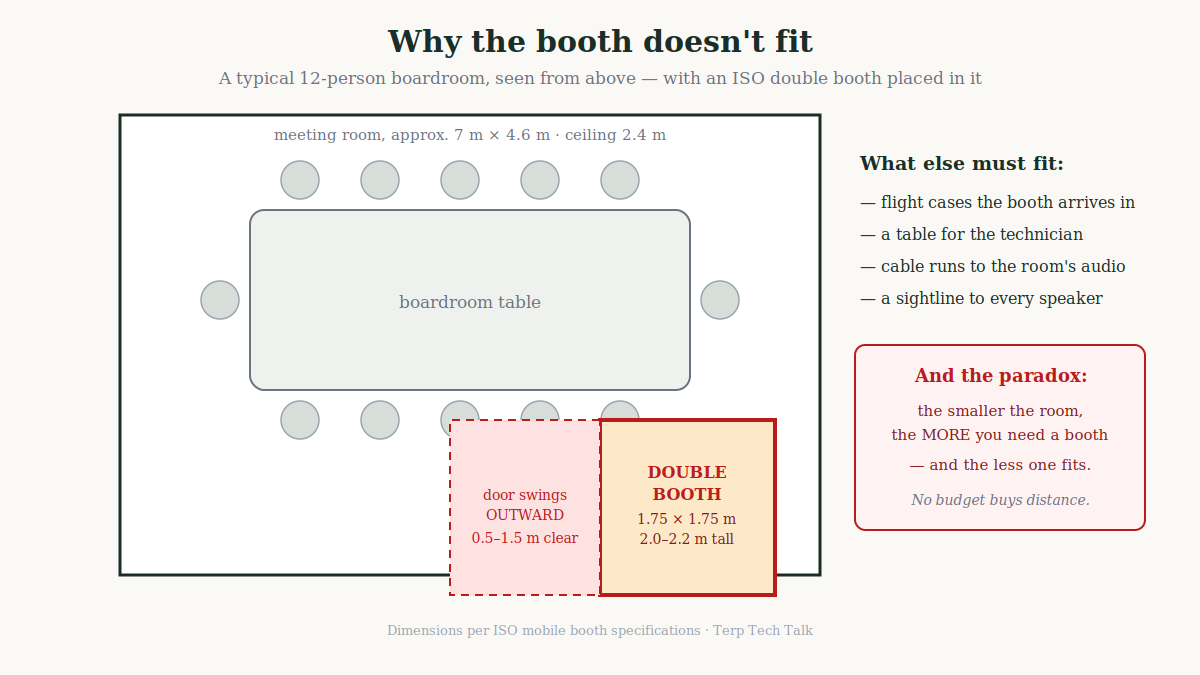
Tabletop booths exist as the compromise, and the honest industry guidance on them is telling: they admit more background noise and are less comfortable, and are suited to short meetings rather than full days. They are a way of failing more politely, not a solution.
This is the constraint that clients find hardest to believe until they have sat through it.
In a large hall, an interpreter without a booth is ten or fifteen metres from most of the audience, with ambient noise and amplified speech between them. In a boardroom, everyone is within two or three metres of everyone else, the room is quiet, and there is nothing at all between an interpreter's voice and the ears of every person who does not need interpretation—including the principals, whose concentration is the entire reason the meeting exists.
This has nothing to do with speaking loudly. When interpretation is carried by a system, the interpreter can speak at conversational level and the listener still hears perfectly. The problem is simply that a voice in a small, quiet room is audible to the whole room. And unlike every other constraint on this list, no amount of budget solves it. You cannot buy silence into a space that has no distance init.
So here is the paradox at the centre of this article: the need for acoustic separation rises exactly as the space available to create it disappears. The smaller the room, the more you need a booth—and the less one fits.
Twenty years ago, getting a floor feed out of a meeting room meant asking for a line output. Today, most corporate rooms have been rebuilt around networked audio—Dante, AVB, AES67—with the processing in a rack and the whole chain digital end to end.
This is better innearly every way, and it has one consequence for us: there may be no analog output at all. Reference designs for modern conference rooms state plainly that no analog outputs are required in the setup, because the microphones, the processor and the amplifier all live on the network.
Getting audio out of such a system is not a cable. It is a change to a licensed, configured, IT-coordinated installation—deployment of these systems requires close cooperation between the AV integrator and the IT team over addressing, switching and network to pology. For a meeting in three weeks, that door is shut.
Conference venues expect vendors. Corporate offices do not.
Bringing equipment into a corporate floor means visitor registration, escorts, after-hours access approval, a loading dock booking, building management sign-off, sometimes an insurance certificate—and coordination across facilities, IT, security and the business team hosting the meeting. Every one of those is a person who can say no, or simply not reply in time.
At a large conference, interpretation equipment is a line item among many, and the per-delegate cost is small. For a ninety-minute board meeting with three people who need a language, the same equipment package costs more than everything else in the room combined—including, quite possibly, the meeting itself.
Which is why, in practice, most corporate multilingual meetings are simply run badly: consecutive interpretation that doubles the length of the meeting, or whispering that tires the interpreter and distracts the room.
Whispering is genuinely correct for one listener. At two it is strained, at three it stops being simultaneous interpretation and becomes a disturbance with a listener attached.
Consecutive doubles the meeting. For a board with a full agenda and people who have flown in, that is the most expensive option on the table, and it is usually chosen because it looks like the cheapest.
The in-house tour guide system—the bidule many corporate hosts already own—deserves a longer answer, because it looks like it should work and doesn't.
The first problem is that it is half a system, as I wrote a fortnight ago: it transmits but has no way to give the interpreter a floor feed.
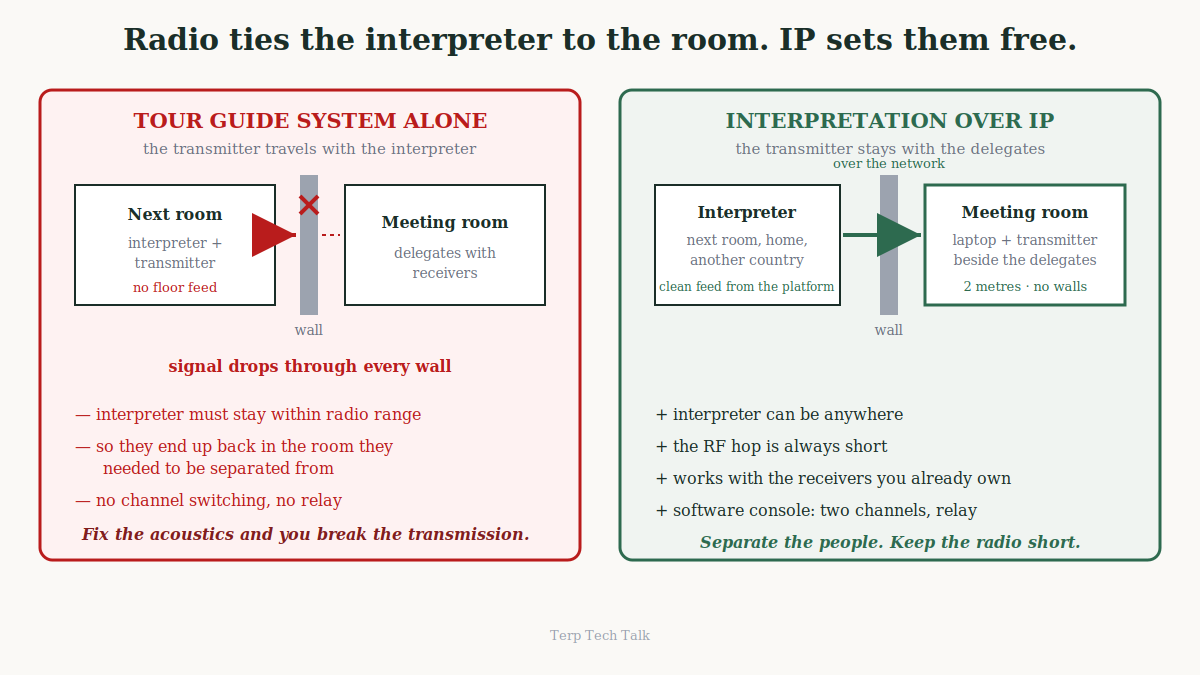
The second problem is the one I want to spend a paragraph on, because almost nobody has named it. A bidule transmitter travels with the interpreter. So the interpreter has to be within radio range of the listeners—which means in the room, or close to it, with signal strength dropping at every wall in between. The technology physically ties the interpreter to the space they are supposed to be acoustically separated from. Solving the acoustic problem breaks the transmission, and solving the transmission problem recreates the acoustic problem.
There is a hardware answer: buy an interpreter console, wire the interpreters into an adjacent room, and use the bidule only for distribution. I know of exactly one corporate site near me that has done it. It works, it cost a one-off purchase most companies will never make for a handful of meetings a year, and it is rare enough that most interpreters have never seen it.
And the third problemis switching. Here I will let a colleague describe it, because his account is better than mine. The head of a foreign ministry's translation service wrote to me recently about their standard setup: a mobile bidule system, two target languages, which normally requires two interpreters each holding their own transmitter. He had tried to run both himself—two microphones in front of him, one per language, muting each before unmuting the other.
After twenty minutes he was exhausted.
That is not a skill problem. That is what happens when a task designed for a console is performed with two handheld radios. And relay—taking another booth's output rather thanthe floor—is not merely difficult on such a setup. It is impossible.
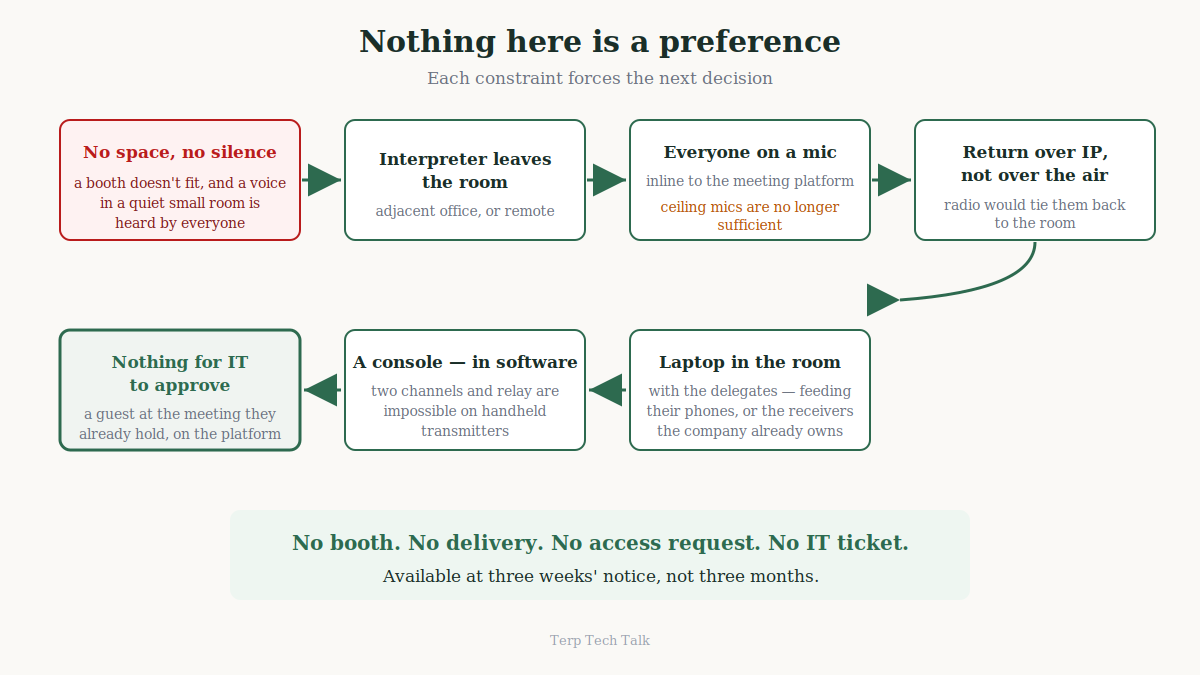
Work through those constraints and the solution is not a matter of preference. Each step forces the next.
The interpreter cannot be in the room, because there is no acoustic separation to be had and no space for a booth that would create it.
So the interpreter needs a feed, which means every participant must speak into a microphone that is inline with the meeting platform—and this is the single most useful thing you can tell a corporate client. If a meeting needs interpretation, ceiling microphones are no longer sufficient. Everyone on a mic, and the interpreter hears the same clean signal whether they are next door or on another continent.
The interpretation must return over the network, not over the air, because radio ties the interpreterto the room and IP does not. This is the inversion that changes everything: the audio travels as data to a laptop sitting with the delegates, and the transmitter—if one is used at all—sits there too, two metres from the receivers with no walls in between. The interpreter is now free to be anywhere.
Delegates listen on whatever suits the room—their own phones, or receivers fed from that laptop if the client already owns a tour guide system, or the company won't have phones in the room.
And with two languages, or any relay, there must be a console—a real one, with channel selection andmic control, because the alternative is the twenty minutes described above. That console no longer has to be a rack-mounted box; it can be software on the same laptop. But the function is not optional.
There is one more requirement, and it is the one that kills most solutions before they start.
Before agreeing to anything, a corporate client should ask a vendor a single question: what will our IT department need to approve?
The usual answer is a list of domains to be white listed—sometimes including third-party infrastructure that isn't even the vendor's—and a range of network ports to be opened. In a bank, a pharmaceutical company or a government ministry, that means a ticket, a security review and a change window. For a meeting in three weeks, it is frequently the end of the conversation. And it repeats for every vendor the client ever trials.
The answer that works is the boring one: nothing.The interpreters join the meeting the client's own staff are already in, on the platform the client's IT has already approved. No new system to assess, no exception requested, no policy touched.
That is worth understanding as a category distinction, not a feature. Most interpretation platforms ask to become a resident in the client's network—new domains, a newd at a processor, new firewall rules. The alternative is to arrive as a guest at a meeting the client is already holding. No security team objects to a guest.
If you are asked whether their boardroom can have simultaneous interpretation, the answer is yes, and the shape of it is this: no booth, no equipment delivery, no access request, no IT approval. Interpreters work from an adjacent room or remotely. Everyone in the meeting speaks into a microphone. Listeners use their phones, or the receivers the company already owns. The meeting stays on the platform it was already on.
It costs a fraction of an equipment package, and it is available at three weeks' notice rather than three months.
And if you are the interpreter being asked, this is the difference between quoting a job and declining one.
Do you need an interpretation booth for a small meeting? No. A standard double booth needs about three square metres plus clearance and a 2-metre-plus ceiling, which most corporate meeting rooms cannot provide. For small meetings,the practical approach is to place interpreters in an adjacent room or remotely, with the interpretation delivered to listeners over the meeting platform or to receivers in the room.
Can interpreters work from another room in the office? Yes, and for corporate meetings it is usually the best arrangement. It requires that interpreters receive a clean audio feed—which means every participant speaks into a microphone inline with the meeting platform—and that the interpretation returns over the network rather than by radio, since radio range drops sharply through walls.
Why can't we just use our tour guide system for a boardroom meeting? A tour guide system transmits but provides no floor feed to the interpreter, and its transmitter travels with the interpreter, so it ties them to the room they need to be separated from. It also offers no channel switching, which makes two-language work exhausting and relay impossible.
Is whispered interpretation enough for a board meeting? For one listener, usually yes. For two or three, whispering becomes a constant disturbance in a small, quiet room where every person is within a few metres of the interpreter—and no budget can create acoustic distance that the room does not physically have.
What does interpretation in a corporate office require from IT? It should require nothing. If interpreters join the organisation's existing meeting on its already-approved platform, no new domains, ports or vendor systems need assessment. Ask any vendor this question in writing before committing, because white listing requests frequently take longer than the lead time to the meeting.
Do ceiling microphones work for interpreted meetings? Not adequately. If a meeting requires interpretation, every participant should speak into a microphone connected inline to the meeting platform, so the interpreter receives a clean, consistent signal rather than a distant room capture.
Disclosure, as always: my company builds interpretation technology, including the software console and delivery described above, and I have an obvious commercial interest in this argument. The constraints are not mine, though—they are physics, ISO booth dimensions and corporate IT policy, and they apply whoever you buy from. If a supplier canmeet all of them, hold them to it; that outcome is also good for the profession.
If this piece was useful, forward it to a colleague who has ever tried to explain to a client why the boardroom is harder than the conference hall.
Accredited English-Mandarin (Chinese) Consultant Conference Interpreter based in Singapore, Member of AIIC and ATA
Remote Simultaneous Interpreting (RSI) Expert
If you want me to provide you Interpretation/Translation service in English to Chinese (Mandarin) and vice versa, or a quotation for conference interpreting services of any languages, simply contact me by phone or email.
Dr. Bernard Song
Mob: (+65) 9478 0176
Tel: (+65) 6610 6718
Email: psong@BernardSong.com
© 2026. Bernard Song. All Rights Reserved.


